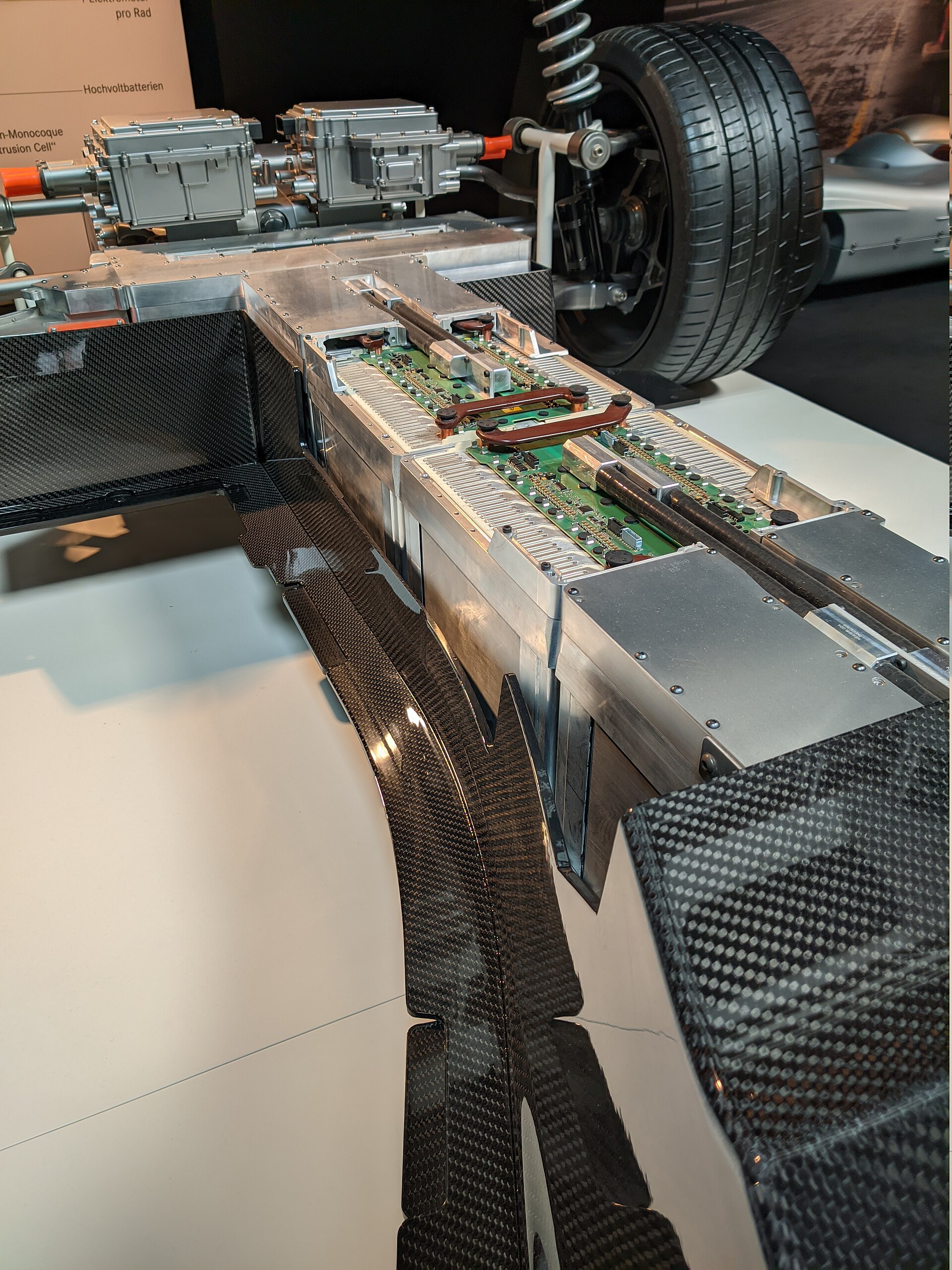
Display of EV battery and drivetrain components. Reference illustration only; it does not document the offered vehicle, a battery test, local service availability or a warranty claim. Battery pack of an EV.jpg - Mugel2110 · CC BY-SA 4.0. Wikimedia Commons proportional 1920 × 2560 rendition; no additional local pixel edits or crop.
Before paying for an EV bound for an African market, confirm who would handle a battery-warranty claim for that VIN, which market terms apply and how the vehicle could reach an accepted repair provider. Check import eligibility and battery condition separately.
Battery-warranty terms in Latin America must be verified by the exact destination market and VIN. A warranty period published in one country cannot be copied to another market or to a parallel-import vehicle without evidence.
A used Chinese EV can reduce the purchase price, while a new vehicle may offer cleaner documentation, more predictable condition and a clearer warranty start point.
A buyer sourcing a Chinese PHEV for Latin America should choose the destination country first, then verify homologation, emissions/energy evidence, charging interoperability, safety-rating scope and the exact after-sales chain.
A Middle East PHEV purchase must be country-first. Saudi import checks, Dubai charging rules, thermal conditions, fuel specification and service access cannot be replaced by a generic “GCC-ready” sales claim.
A spare-parts plan should be built before the first vehicle shipment, not after the first customer car is immobilised. The goal is not to stock every component.
A battery warranty should not be treated like wheelbase, battery capacity or motor output. The same manufacturer can publish different warranty conditions in different markets.
Regional monitoring shows expanding electrified light-duty fleets and charging networks across Latin America and the Caribbean, but deployment is uneven between countries and cities.
For an African route; pre-export inspection; tyre availability; A neighbouring market's clearance or registration is only a lead; freeze seating layout; luggage volume at full occupancy; cabin cooling; driver training; Confirm the exact vehicle or shipment identity, legal route, passenger load, rough-road downtime, cooling and parts replenishment, destination acceptance and the responsible party for every unresolved cost or service item.
For the Middle East; cooling reserve; telecommunications; A certificate described as GCC or Middle East specification is not self-proving; freeze seating layout; luggage volume at full occupancy; cabin cooling; driver training; Confirm the exact vehicle or shipment identity, legal route, heat load, sand exposure, conformity, port storage and cooling support, destination acceptance and the responsible party for every unresolved cost or service item.
Compare new and used EV offers only after checking the destination registration route, VIN-linked condition and usable local support. Saudi individual-import rules and the UAE used-import status service illustrate why a lower vehicle price alone cannot establish a saving.
Compare a new and a used EV under the same destination and registration route. Singapore LTA publishes a vehicle import and registration guide; Malaysia MITI publishes motor-vehicle Approved Permit information.
For Latin America; charging payment; workshop software; freeze seating layout; luggage volume at full occupancy; cabin cooling; driver training; Confirm the exact vehicle or shipment identity, legal route, mountain operation, fuel quality, homologation and regional parts support, destination acceptance and the responsible party for every unresolved cost or service item; Latin America is not a single vehicle-admission zone.
Do not compare a generic “CIF Africa” figure. State the destination country, importer of record, discharge terminal, final registration market, expected arrival and physical handover point.
Put the destination country, discharge terminal, importer of record, expected declaration date, final registration city and handover point on page one.
State the destination country, discharge terminal, importer, final city or island, expected declaration date, registration market and physical handover.
The Middle East is not one registration market, and Gulf Cooperation Council states retain national processes. Saudi SASO provides an import service and calls for conformity to be checked before shipment.
The ASEAN Automotive Product Mutual Recognition Arrangement covers listed components and systems and uses relevant UN Regulations as a technical basis.
Name the country, registration city, operating model and expected annual distance. UNEP's programme map illustrates uneven market development across countries and vehicle segments.
ASEAN guidance maps differences among member states in vehicle approval, charging, battery performance, testing and swapping. State the country, registration city or island, duty cycle, import status and intended charging.
Illustrative display of battery and drivetrain components. This photograph does not document an inspection, a battery condition result or warranty coverage for a vehicle offered for sale.Battery pack of an EV.jpg | Mugel2110 · CC BY-SA 4.0 · Commons-provided proportional 1920 × 2560 rendition; no additional cropping or editing.
Check the local issuer, applicable terms, remaining cover, battery-condition evidence and repair route; a European extension or registration approval does not establish local warranty entitlement.
For “Buying Chinese SUVs in Southeast Asia: verify the country variant before comparing safety, monsoon use and charging”, the scope boundary is tested against the direct record ASEAN Secretariat — ASEAN for Business - Automotive Product Mutual Recognition Arrangement — https://asean.
For “FOB vs CIF vehicle quotes for Africa: price the port and inland corridor”, the scope boundary is tested against the direct record International Chamber of Commerce — Incoterms 2020 Checklist and Flowcharts — https://library.
FOB and CIF allocate delivery, risk and specified costs; they do not settle destination customs or registration requirements. Compare each quote against the separate procedures in Brazil, Colombia, Peru and Chile, using the same endpoint.
For “FOB vs CIF vehicle quotes for the Middle East: separate Gulf conformity from cost”, the scope boundary is tested against the direct record International Chamber of Commerce — Incoterms 2020 Checklist and Flowcharts — https://library.
For “FOB vs CIF vehicle quotes for Southeast Asia: include permits and island delivery”, the scope boundary is tested against the direct record International Chamber of Commerce — Incoterms 2020 Checklist and Flowcharts — https://library.
Latin American vehicle fleets reflect European, North American, Japanese, Chinese and domestic supply chains. Depending on age and origin, vehicles may carry Type 1, Type 2, CCS1, CCS2, CHAdeMO or GB/T.
The Middle East does not have one charging regulation that automatically applies across every country. Dubai's DEWA publishes an infrastructure regulatory framework and technical requirements.
Singapore's LTA requires chargers to meet national technical standards and follow type approval, installation certification and registration processes.
State the country of registration, importer, vehicle category, new or used status and private, ride-hailing, taxi or fleet use. Southeast Asia contains both right- and left-hand-drive markets.
Before quotation, name the country of final sale and registration, entry port, importer, category, commercial or personal route, new or used status, model year, powertrain, steering side and expected arrival.
Do not let an odometer reading or the word new decide the category. Record the build date, first-registration date, title status, any previous licence, warranty start and VIN.
The 2021 ASEAN Mutual Recognition Arrangement on Type Approval for Automotive Products is intended to reduce duplicate assessment for covered automotive products and related UN Regulation approvals.
Write a compliance brief naming the final country of sale or registration, vehicle category, intended use, new or used status, powertrain, steering position, proposed application date and legal importer.
Fix the final country and city, importer, commercial or personal route, category, new or used status, powertrain, manufacture, expected arrival and registration date.
Africa is not a single customs or vehicle-approval territory. Requirements for new and used vehicles, age, emissions, left- or right-hand drive, pre-shipment inspection, importer status and registration documents vary by country.
Rapid global EV growth does not make one electric hatchback universally registrable. Import eligibility, whole-vehicle approval, steering position, lamps, radio equipment, charging hardware and taxation are destination matters.
Africa is not one vehicle-approval or customs territory. Rules for new and used vehicles, age limits, emissions, left- or right-hand drive, pre-shipment inspection, taxation and registration differ by country and can change.
Charging compatibility is often reduced to the outline of a plug. In practice, it spans the vehicle inlet, cable and coupler, charging equipment, electrical operating limits and communication stack.
China introduced export-licence administration for the pure electric passenger vehicle category specified in a joint announcement, effective 1 January 2026.
The same vehicle may leave China as an unregistered new vehicle, a recently registered vehicle or an ordinary used vehicle. Those routes do not carry the same documents, responsibilities or risks.
Latin America is not one automotive territory. Duty, value-added tax, incentives, type approval, safety documents, new or used eligibility and registration are national matters that may move with fiscal and industrial policy.
Southeast Asia is not one vehicle market. Left- or right-hand drive, whole-vehicle approval, new or used eligibility, import support, local-production conditions, taxes and registration documents are national matters.
Before requesting a firm price, identify the country of final registration, importer of record, private or commercial use, vehicle category, new or used status, build and first-registration dates, steering side, powertrain and intended arrival window.
The enquiry should identify the final country, corporate or individual importer, commercial sale or personal use, new or used status, build and first-registration dates, category, powertrain, accident or modification status and entry port.
Specify whether the destination is Saudi Arabia, the United Arab Emirates, Oman or another state; whether the importer is a business, citizen, resident or special-status party; whether the unit is for resale or personal use; the sea or land entry; and the place of registration.
Identify Singapore, Malaysia, the Philippines, Thailand, Indonesia, Vietnam or another final state; whether the importer is an authorized distributor, parallel importer, business, individual or special party; and whether the vehicle is for retail, personal use or a fleet.
Southeast Asia is not a single admission, steering, charging or commercial-vehicle market. Begin with the destination country and city, then define whether the vehicles will carry staff, passengers, parcels or service equipment.
Southeast Asian states apply different rules to new, used, personal and parallel imports, model years and steering position. Name Singapore, Malaysia, the Philippines, Thailand, Indonesia, Vietnam or the final destination.
Toyota Hilux exterior illustration, not the Ford Ranger document example. This photograph does not document an inspection, load test or approval for Brazil, Peru or Argentina.2016 Toyota HiLux Invincible D-4D 4WD 2.4 Front.jpg | Vauxford · CC BY-SA 4.0 · Proportionally scaled to 1920 × 952 using the Commons rendition; no additional image edits.
Match the offered pickup to destination approval, crew requirements and configuration-specific load evidence before accepting a fleet quote for Brazil, Peru or Argentina.